ServicesTurboprop Charter
Turboprop Charter Flights in Beech Grove
For a short regional flight, a turboprop is frequently the most practical aircraft. We lay out how it compares with a jet, what you trade and what you get, and then price the trip point to point in a single all-inclusive quote so you can take your time deciding.
What a turboprop is, and when it makes sense
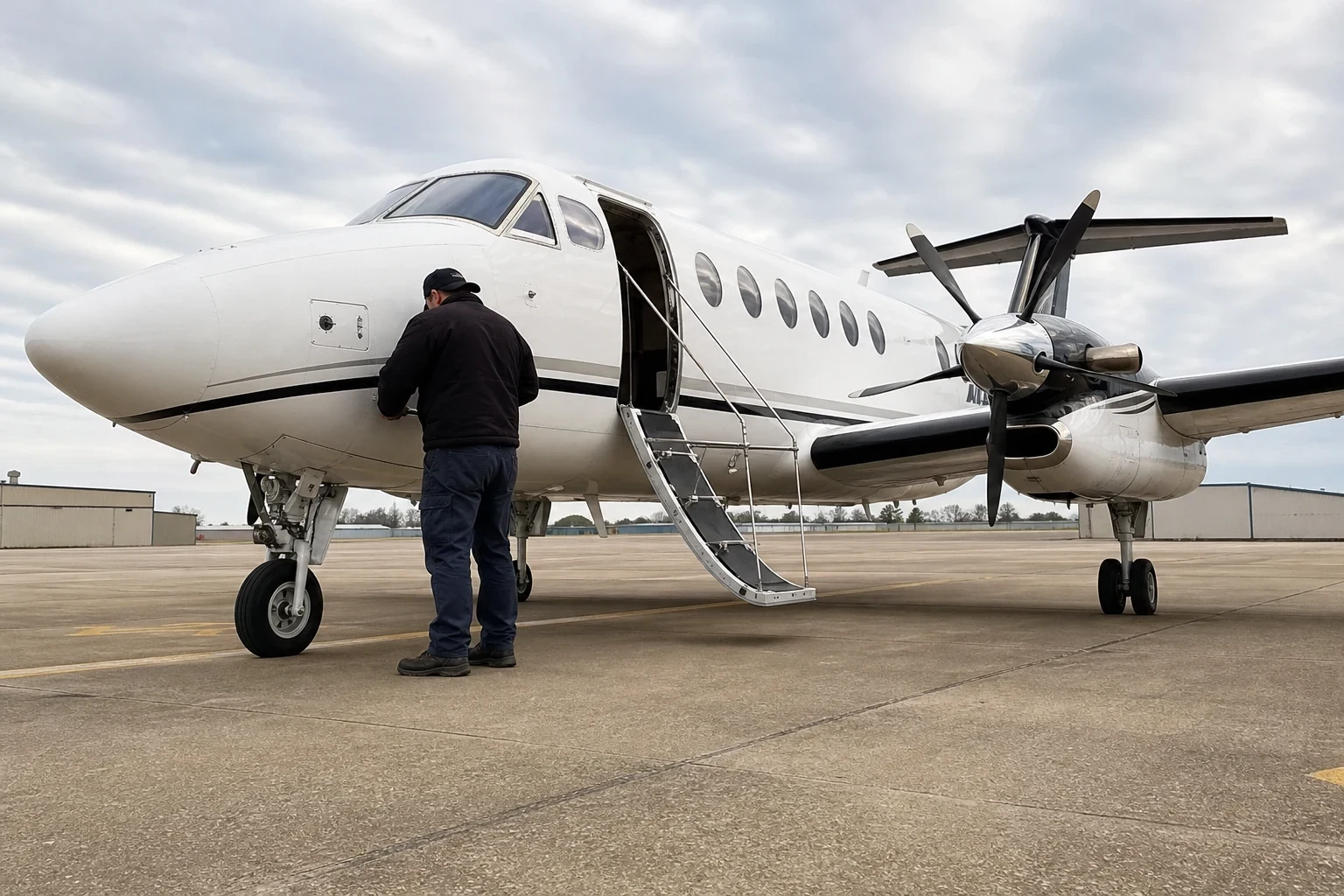
A turboprop uses a jet turbine to turn a propeller. In practice that means an aircraft that burns less fuel on short legs, climbs well and can use shorter runways. Common examples in charter work are the Pilatus PC-12 and the Beechcraft King Air family, with cabins that typically seat six to eight passengers.
The trade-off is speed. A turboprop cruises noticeably slower than a light jet, so on a trip of a few hundred miles the difference is often minutes, while on a long cross-country flight it can be hours. We will tell you plainly which side of that line your trip falls on.
For travelers in Beech Grove, Greenwood and the wider Indianapolis area, turboprops fit well for regional business days, family visits and trips to destinations served by smaller airfields.
What a turboprop charter covers
An aircraft matched to the route
We look at how far you are going, how many are flying, what you are packing and the runway on both ends before we suggest an aircraft. If a light jet fits the trip better, we say so.
A Part 135 carrier at the controls
Your trip is operated by an FAA-certified Part 135 air carrier, the set of U.S. rules that governs on demand commercial charter.
One figure, all-inclusive
Your quote already counts the aircraft, crew, fuel and the usual taxes and fees. After you say yes, no hidden costs appear.
Point to point pricing
You pay for the legs you fly and nothing more. One-way travel is never charged at round trip pricing.
Pets and WiFi
Your pets are welcome, and we can look for WiFi equipped aircraft if you need to stay online. Mention either on the call and we will confirm it on the specific aircraft you book.
FBOs set at departure and arrival
We confirm the FBO on both ends, so you know where to park, where to meet the crew and roughly how early to arrive.

Signs a turboprop is the right call
- Your trip is short to medium
- For flights of roughly a few hundred miles, a turboprop's lower speed costs little time, and the operating savings can be meaningful.
- Your destination has a small airfield
- Many turboprops are comfortable on shorter runways. That can put you closer to a plant, a lake cabin or a small-town meeting than the nearest airline airport would.
- You are flying a small group
- Six or so passengers with normal luggage fit well. Larger groups or heavy gear usually point toward a midsize jet charter.
- Value matters more than speed
- If arriving twenty minutes later is fine and the budget is a real consideration, a turboprop is worth pricing alongside a jet.
- You need to go on short notice
- Turboprops are widely available, which can help when plans change late. Trips can be arranged around the clock, subject to aircraft and crew availability.
From the first call to takeoff
- 1
Talk it through by phone
Share the where, the when and who is coming, along with luggage and any pets. We go over the aircraft choices in everyday language, including times a turboprop is the wrong pick.
- 2
Go over your all-inclusive quote
We walk through a quote that lists the aircraft, the operator and everything included. Ask about any line you like before you decide.
- 3
Confirm and get the details
After you confirm, we send the FBO, a suggested arrival time and the passenger information the operator asks for. Any changes are handled over the phone.
- 4
Board and go
Show up at the FBO, meet your crew and board with no airline lines. Most travelers are seated just minutes after they walk in.
What moves the price of a turboprop flight
Turboprop pricing is driven mainly by flight time, since you are paying for an aircraft and crew by the hour. A few other details shift the number. We walk through each one so the quote makes sense before you commit.
- Distance and flight time
- Longer legs mean more hours. On longer trips a jet's speed can narrow or erase the turboprop's cost advantage.
- Where the aircraft starts
- If the nearest suitable turboprop is based elsewhere, repositioning time to your departure airport may be part of the price.
- Waiting and overnights
- Day trips with a long wait on the ground, or trips that keep the crew overnight, add crew and parking costs.
- Date and demand
- Holidays, big event weekends and peak travel days tighten availability. Flexible timing, or an empty leg, can help.
Common turboprop questions
- Is a turboprop as safe as a jet?
- A turboprop's turbine engine works on the same basic principle as a jet engine and has a strong record for reliability. A Part 135 carrier flies your trip under the FAA's commercial charter rules, which include crew training and maintenance requirements. We can give you the operator's name along with your quote.
- Will it be louder or rougher than a jet?
- The cabin is somewhat noisier than a jet's, and turboprops usually fly lower, so on some days you may feel more of the weather. Pressurized aircraft such as the PC-12 and King Air keep the cabin comfortable on typical regional flights.
- Does the aircraft have a restroom?
- That varies by aircraft. Some turboprops have an enclosed lavatory, some a simple one and some none at all. If you need one, say so and we will quote only aircraft that have it.
- How many bags can we bring?
- A carry-on plus a checked-size bag for each person usually fits well, though weight limits and cabin layout differ. Mention golf clubs, ski bags or equipment so we can make sure it fits before you book.
- Is there anything to sign up for before booking?
- No. There are no memberships or long term commitments. Each trip is booked on its own and priced point to point.
See whether a turboprop suits your trip
Give us the route, the date and how many are flying. We will go over your choices in everyday language and take you through an all-inclusive quote.